· 7 min read
Wood or Composite Fencing: What Actually Lasts in the GTA Climate
Both wood and composite last in the GTA — what decides it is the post, not the picket. Freeze-thaw at Toronto Pearson, ground-contact ratings, fastener corrosion, and what a composite fence system actually is underneath.
Updated
Both last. The material is not what decides it.
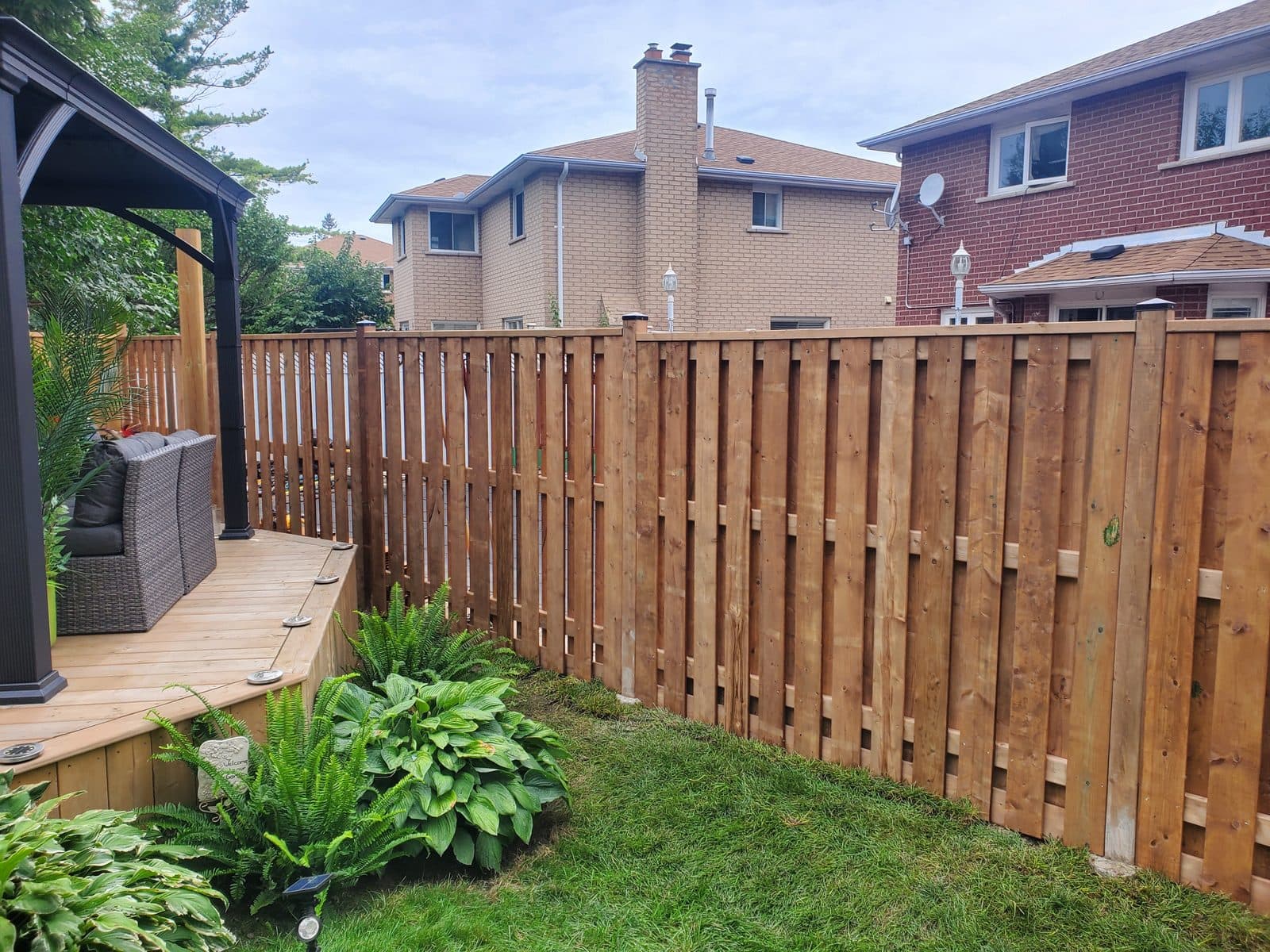
The Canadian Wood Council's treated-wood FAQ notes that "service lives of over 60 years have been documented for treated fence posts in ground contact" — then immediately qualifies it: "given the correct specification, quality control and installation" (Canadian Wood Council). That qualifier is the whole article. In the GTA, wood and composite fences fail in the same three places: the post, the ground line, the hardware. Choose your material on how you want to spend the next ten years — staining, or not staining — then spend your attention on the parts nobody photographs.
The GTA doesn't have a cold winter. It has a wobbling one.
A steady −20 °C winter is easy on a fence. Ours isn't that. Environment and Climate Change Canada's 1991–2020 climate normals for Toronto Lester B. Pearson Int'l A put December's average daily maximum at 1.9 °C against an average daily minimum of −5.0 °C; March runs 5.0 °C by day and −3.8 °C by night (ECCC Canadian Climate Normals).
The average December day and the average March day both cross the freezing point. Water in the topsoil, in the end grain of a post and in the joint between picket and rail makes that transition over and over — a load indifferent to what the pickets are made of. It works on the post, the concrete around it and every fastener in the run.
Above ground is a maintenance question. Below ground is a durability question.
Decay isn't weather, it's biology, and biology needs water. Paul Morris of Forintek Canada and Jerrold Winandy of the USDA Forest Products Laboratory put it plainly in Limiting Conditions for Decay in Wood Systems: wood "will decay above 30% moisture content and will not decay below 20% moisture content," with 20–30% "a grey area" and the 20% line treated as "a margin of safety against fungal decay" (USDA Forest Products Laboratory).
A picket six inches off the ground dries after every rain and spends most of its life under that line. A post buried in soil never gets the chance. Failure shows up at or just below grade — the band where wood is wet, warm and oxygenated at once. Almost everything that sets a wood fence's lifespan is a decision about that band: is the post rated for it, does it drain, will the hardware near it survive.
What "pressure-treated" actually buys you now
Residential treated lumber changed a generation ago. Consumer treated wood moved off chromated copper arsenate in the early 2000s, and the Canadian Wood Council records that since 2004 the two most widely used replacements for non-industrial work have been alkaline copper quat (ACQ) and copper azole (CA) (Canadian Wood Council). Both are copper-based, and a copper-based preservative "chemically bonds to the wood; in other words, it is 'fixed' in the wood and cannot diffuse throughout the piece nor can it wash out." Three consequences separate a fence that lasts from one that doesn't.
The end tag is not decoration. Wood Preservation Canada is explicit that the tag stapled to the lumber identifies whether it was treated for "Above Ground Only" or "Ground Contact," and that ground-contact stock "has a higher preservative retention level than above ground" (Wood Preservation Canada, Building Tips). A post is ground contact. An above-ground-rated post dropped in a hole is a common reason a five-year-old fence is already loose.
Every cut exposes untreated wood. WPC is unambiguous: "All cuts and holes expose untreated wood and should be brush-coated with two applications of a registered end-cut preservative before the wood is installed" — copper naphthenate for anything going into ground contact. So when posts get trimmed to height after they're set, that fresh cut needs treating before the cap goes on. Skipped, it's a slow leak in an otherwise sound fence.
Copper is hard on ordinary hardware. The CWC is blunt: only hot-dipped galvanised or stainless steel nails should be used with CCA-, CA- or ACQ-treated wood, because "electroplated galvanising is not thick enough to resist the corrosion effects under moist conditions." WPC points to hot-dipped galvanized fasteners to ASTM A153 with ASTM A653 G90 hardware, and stainless types 304 and 316 for severe exterior applications. The safety text on that same end tag warns against using preserved wood in direct contact with aluminum — and WPC's fuller guidance is preservative-specific: for CA- or ACQ-treated wood used close to aluminum products, put a building-code-approved membrane between the two, and never encase or wrap treated wood in aluminum where water can be trapped. That one catches people on gate hardware and mixed-material details. Read the tag on the lumber that actually arrives, because it names the preservative and the answer depends on which one it is.
Cedar is not automatically the durable choice
Cedar earns its place on appearance, workability and how well it takes a stain. Its rot resistance is real but narrower than its reputation. The CWC's framing: the heartwood of western red cedar and similar species will "resist decay to some degree, but it is variable," and "the sapwood of all species is considered non-durable." It concludes that wood treated to CSA standards "will deliver more reliable durability performance on average than a naturally durable species."
The practical read: cedar above ground, ground-contact-rated treated below it. That isn't a compromise — it's the correct build.
What composite fencing actually is
Composite fencing isn't a lumber choice, it's a system. Look at what a manufacturer ships: Trex's Seclusions installation guide lists, per 8-foot section, one post, one post cap, four brackets, one top rail, nineteen pickets, two bottom rail covers — and one aluminum bottom rail (Trex Seclusions Installation Guide). Metal is doing structural work; the composite is the skin over it. That's why the layout comes from the guide rather than from your saw: posts go in at a maximum of 96 inches on centre, and that maximum tightens as the ground moves — the guide's own chart takes it to 71-1/2 inches across a steep height transition.
It doesn't exempt you from the ground, either. The same guide has you dig holes "12″ in diameter and 30″ deep (or below frost line)," set the posts in concrete, and "apply for local permit as directed by local code." Treat those dimensions as the manufacturer's baseline rather than as a frost depth for your lot — other printings of the guide word the same step as "depending on local codes," and local code is what governs. The frost problem is identical to wood's. Only the picket has changed.
One thing to know before you sign: ASTM D7032, the standard composite product evaluations are written against, covers wood-plastic composite and plastic lumber "for use as exterior deck boards, stair treads, guards, and handrails" (ASTM D7032-21). Fencing is not named in that scope. Composite fence performance rests on the manufacturer's system, installation guide and written warranty — their document, between you and them, not one your installer issues.
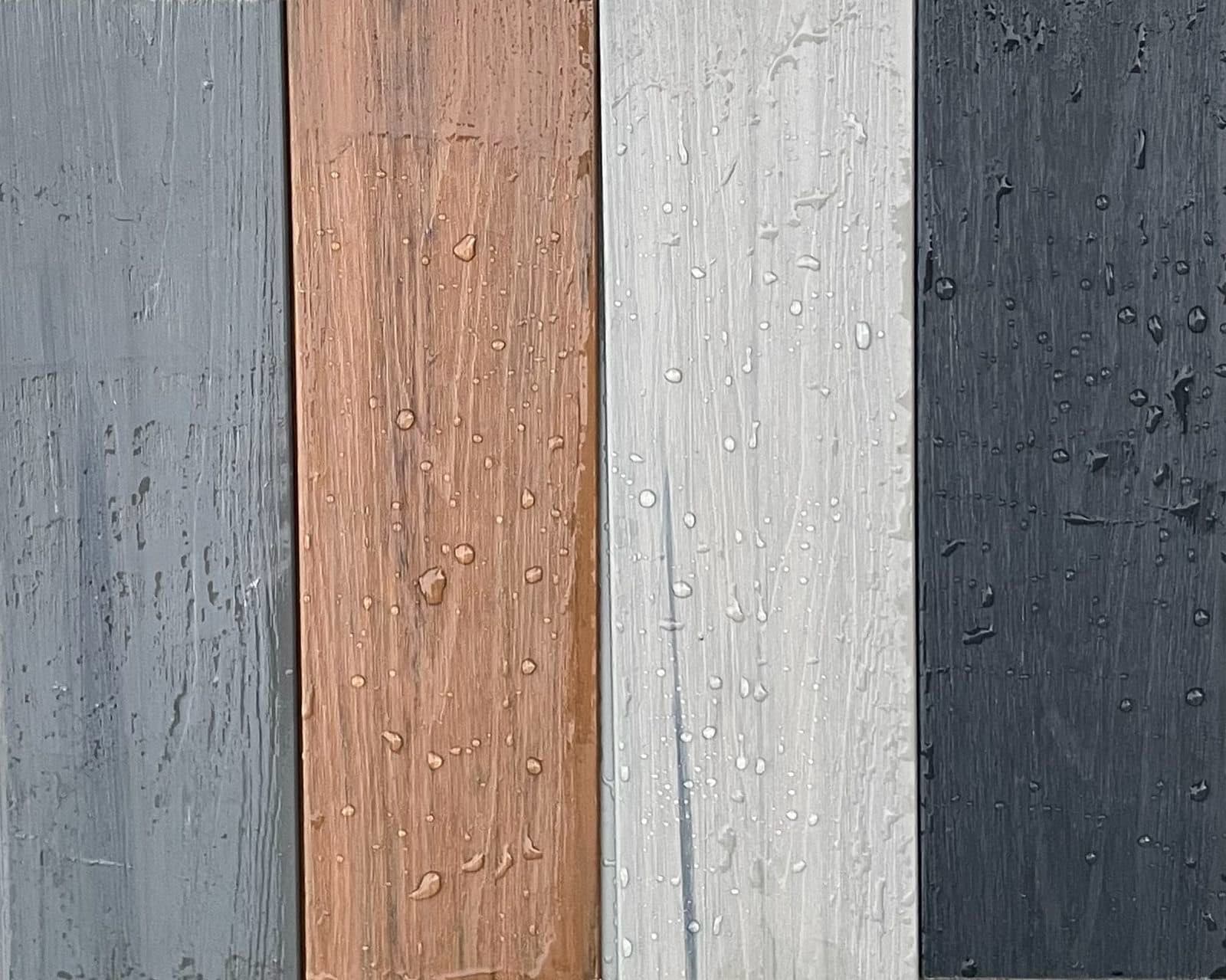
The trade-off is real. Composite doesn't rot the way wood does and doesn't need staining or sealing. In exchange it's a closed system: a damaged picket is a part number, not a trip to the lumber yard, and a discontinued colour is a real risk on a long run. How much it weathers, fades or marks over the years is defined by that manufacturer's own warranty — read what the warranty actually promises, and for how long, before you settle on a colour.
So which one
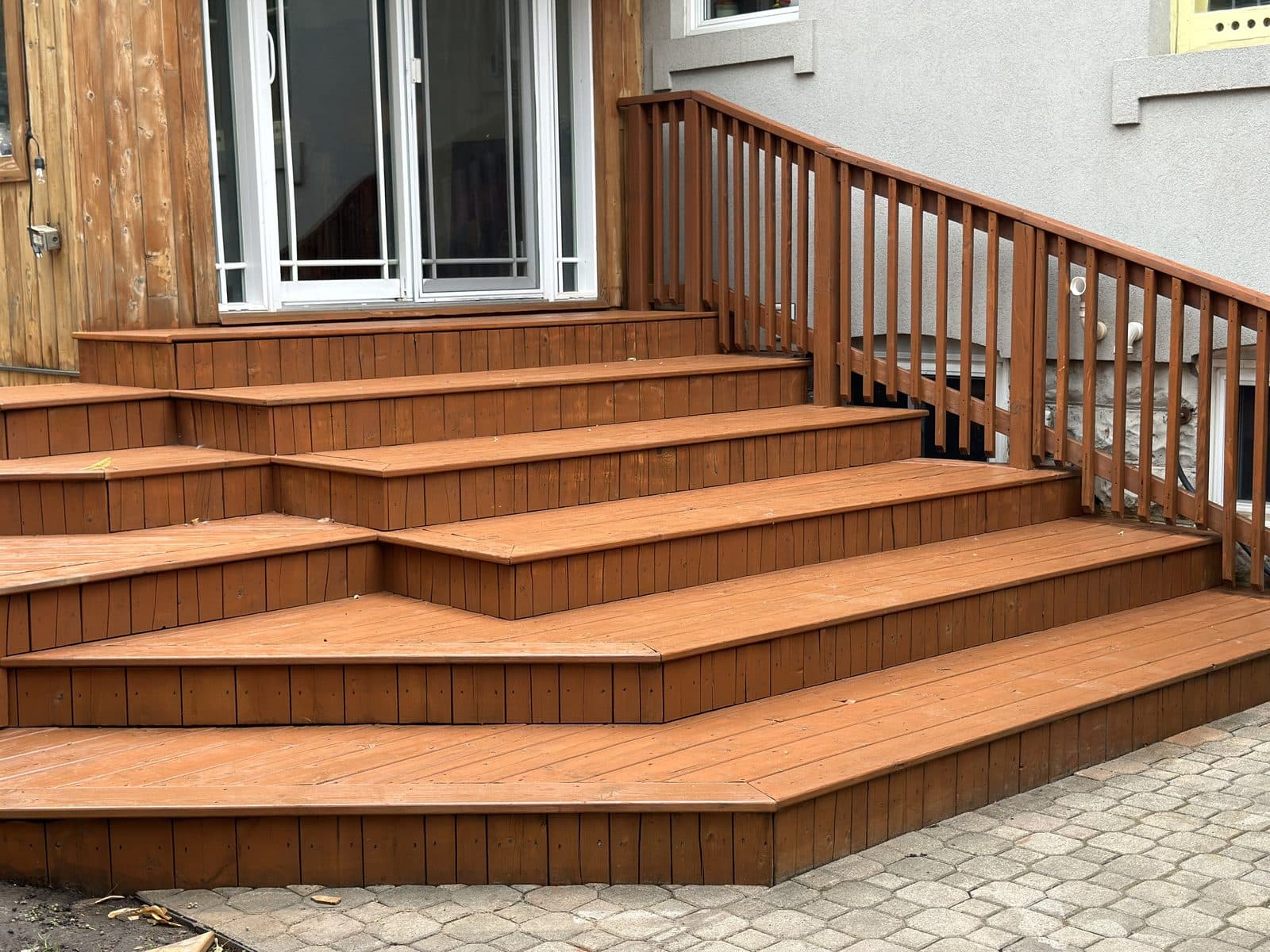
Choose wood if the run is long or the grade irregular, if you like a stained fence and will actually re-stain it, or if you want to extend and repair it with materials any yard stocks.
Choose composite if your goal is to stop maintaining the fence and you're content with the manufacturer's post spacing and detailing.
What you shouldn't do is choose composite believing it removes the hard part. The hard part is in the ground, and both systems put a post there.
Before you order: height, and the neighbour
Fence height is set by municipal by-law, not by your supplier, and the numbers differ across the region. Mississauga's fence page gives a maximum of 2 metres in the back or side yard and 1 metre in the front yard — 1.5 metres if the construction is open (City of Mississauga). On permits the City's own wording is that "you may not need a permit to build a fence in most cases," which is not the same thing as not needing one. Confirm your own property with Licensing, Permits & Regulatory Services before you order material. The City sends corner lots and fences inside a sight triangle back to the by-law itself, and it treats swimming pool enclosures separately — pool enclosure rules are child-safety requirements, so take those from the City directly rather than from any contractor's summary, this one included. Oakville, Brampton, Vaughan, Caledon, Halton and Simcoe all publish their own numbers, and they are not Mississauga's.
If the fence sits on a shared boundary, Ontario's Line Fences Act sets out a dispute-resolution procedure between adjoining owners: the municipality appoints fence-viewers — three must be present at a viewing — who can rule on how responsibility for the work is apportioned between the two owners and on the description of the fence to be built, including the materials. A municipal council may also pass a by-law exempting all or part of the municipality from the Act and assigning line-fence costs itself, so it is worth checking whether yours has. A conversation with the neighbour beforehand is cheaper than any of that.
The first winter is the real test
Whatever you build, the fence line is where snow ends up. Plough throw, snow piled against a panel and meltwater pooling at post bases are how a fence that survived installation loses a season anyway. Worth settling where snow will go before the fence goes in — it is the same question that runs through property maintenance all winter.
FILD Group builds fence and deck across the GTA in both materials. If you're weighing them for your own property, the useful conversation is about your grade, your drainage and your by-law — not the pickets.