· 8 min read
Who Owns the Noise Wall Behind Your House — and Who Pays to Replace It
Ownership turns on which side of the property line the wall sits on, and which authority owns the road behind it. Peel, Mississauga, Brampton, Oakville and Halton publish different terms for retrofits and for replacements, and Toronto says it has no eligibility programme for new sound mitigation.
Updated
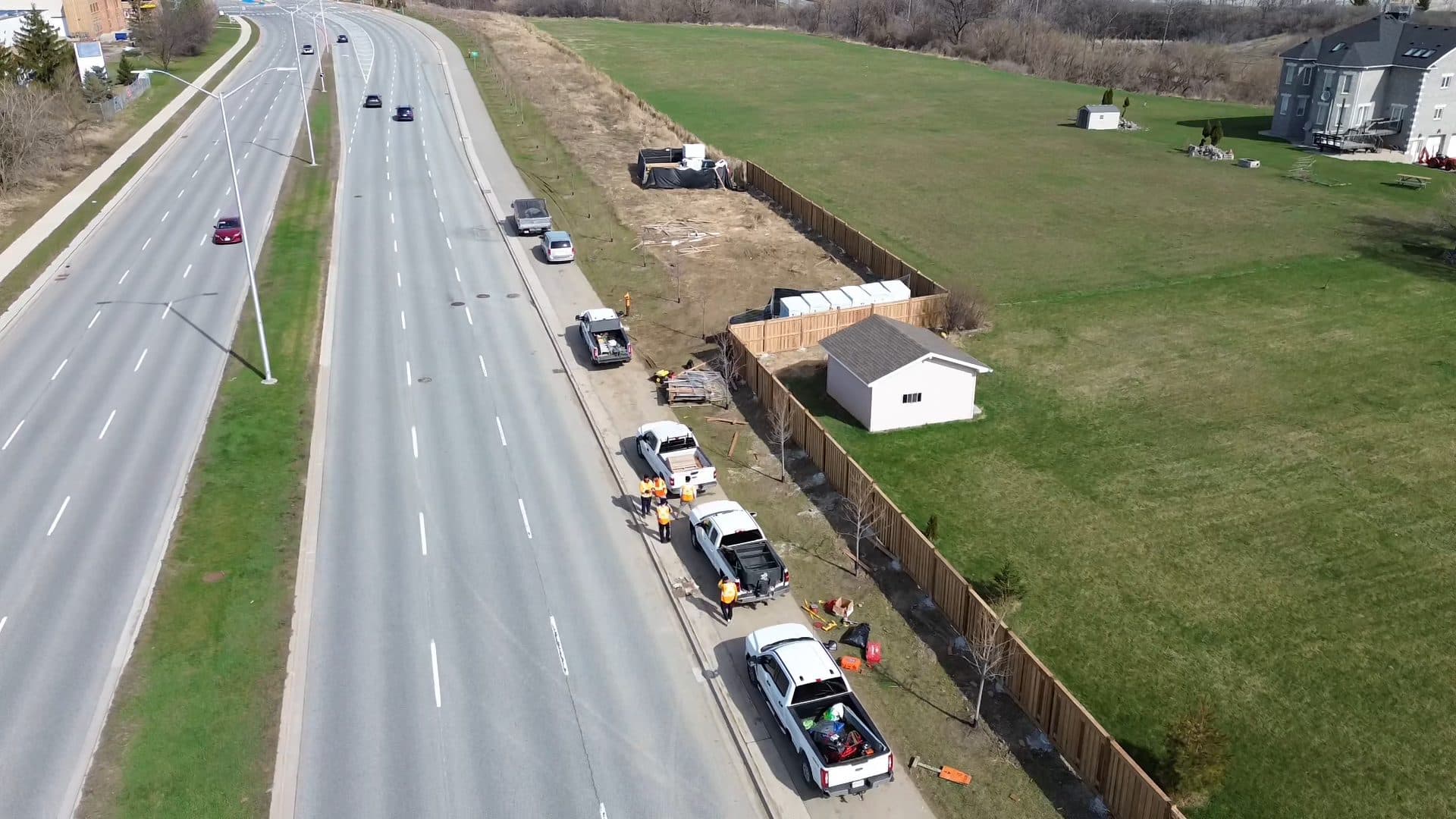
The short answer: whoever owns the ground the wall stands on. If the wall behind your yard sits on your side of the property line, it is in most cases yours to maintain and yours to replace — even though it exists to buffer you from a road you do not own. If it sits on the municipal or regional road allowance, it belongs to the road authority. The complication, and the reason this comes up so often in GTA reverse-frontage subdivisions, is that many of these walls were built by developers on private lots rather than on the road allowance. Some municipalities now run programmes to move that problem back onto public land, and they are not quick: Peel estimates its own conversion programme will span roughly 30 years.
Where the wall sits is the whole question
Region of Peel's policy draws the line plainly. A "Private Noise Attenuation Wall" is "an existing noise attenuation wall on private property with rear yards or side yards abutting a Regional road"; a "Regional Noise Attenuation Wall" is one "built on the property line abutting Regional Property" (Peel Policy W30-04, effective October 13, 2016). Same wall, same road, same noise — the side of the line it stands on decides who writes the cheque.
Halton Region approaches it from the other end. Its Noise Abatement Guidelines require barriers on the Regional right-of-way where feasible, and where that is not feasible, "an easement granted to Halton Region must be given in order for the Region to assume maintenance responsibilities" (Noise Abatement Guidelines, adopted 2014). No easement, no assumption of maintenance.
So the first document to find is not a policy. It is your survey. Caledon's homeowner guide gives advice that applies to any fence: review your property survey, or hire a land surveyor, to make sure the fence is entirely within your property, and carefully review the agreements registered on the title of your property to determine whether they place any additional restrictions on fences (Town of Caledon Neighbourhood Guide). If a clause registered on your title assigns responsibility for maintaining or replacing an acoustic barrier to the owner, that is your answer.
Then find out whose road it is
Which authority owns the road decides which programme, if any, could apply — and some road authorities publish no programme at all. Peel handles Regional roads, and tells residents that if the property is not on a Regional road, the issue goes to Brampton, Mississauga or Caledon instead. Peel publishes a number for exactly this question: 905-791-7800, if you are unsure whether the wall belongs to you or the Region (Private Noise Wall Conversion Program). Brampton says the same thing in reverse: if the source of the noise is a Regional road, contact the Region of Peel.
Halton's guidelines are explicit about their limits. They do not apply to "roadways under the jurisdiction of the Local Municipality, Provincial Highways, railways and other transportation facilities that are not part of the Regional Road System." A wall backing onto a 400-series highway is a provincial matter; a rail corridor is different again.
If your wall is in Vaughan or elsewhere in York Region, or in Simcoe County, go to that road authority directly. This article does not cover their policies, and you should not assume a neighbouring region's rules carry over.
Toronto residents, Etobicoke included, should brace for a blunter answer. A March 16, 2026 Transportation Services report states that "The City of Toronto does not have a program to assess the eligibility to implement sound mitigation infrastructure along municipal roadways or expressways," other than where such requirements arise through the development approval process (Highway 2A Sound Mitigation Update). That report was written about one Scarborough corridor, but the statement is made about the City as a whole. Note what it covers: assessing eligibility for new sound mitigation, not the maintenance of walls the City already owns. Toronto's fence by-law, meanwhile, defines a fence as "a barrier, including one for noise attenuation" (Municipal Code Chapter 447) — so a noise wall on your land is regulated, and enforceable, as a fence.
Retrofit and replacement are two different questions
This is where generalising costs money, and it is where most homeowners go wrong. A brand-new wall where none existed — a retrofit — and the replacement of a wall that is already there are funded on completely different terms, sometimes within the same municipality. Check which one you are asking for before you read any percentage as applying to you.
- Peel Region (Regional roads). Under the Private Noise Wall Conversion Program, eligible private walls are rebuilt onto the property line abutting Regional property, with construction costs "one hundred per cent (100%) funded by the Region," after which the Region owns and maintains the wall. Eligibility is narrower than it first sounds: the policy applies to walls existing as of September 10, 2015 on reverse-frontage lots, homes fronting a Regional road do not qualify, and privacy fences and chain link fences are excluded. Peel inspects private noise walls every three years. Until conversion, repair "will remain the sole responsibility of the property owner." Upgrading a privacy fence to a noise wall is a separate route under Peel's Local Improvement Program, where owners would cover half the project cost.
- Mississauga (City roads). Where an existing barrier on private property requires replacement, the City builds the new one "whenever possible, wholly on City property," "100 percent City funded," and maintains it thereafter. A retrofit where none previously existed is shared "on a 50/50 basis with the abutting private property owner" (Policy 09-03-03, effective April 13, 2011).
- Brampton (City roads). New retrofit walls are "split 50/50 between the affected homeowners and the City"; for replacement of existing walls "the City will cover 75% of the cost and the benefitting homeowners will cover the remaining 25%" (City of Brampton Noise Walls).
- Oakville (Town roads). Under the Town's noise barrier retrofit programme, design and construction are split "75 per cent of costs covered by the Town and 25 per cent covered by the homeowner," and "the Town would be responsible for future noise wall maintenance" (Noise Reduction Walls and Fences).
- Halton Region (Regional roads). Barriers inside the Regional right-of-way are maintained by the Region, and the cost of mitigation required as a result of a Regional road reconstruction or expansion is borne by the Region, which then assumes ownership. Existing barriers not on that right-of-way are maintained by the Region only "upon request from the property owner at the owner's expense" — and at end of service life, owners "must petition the Region... to have the noise barrier replaced or replace the noise barrier themselves."
Different road authorities, different answers, and in Toronto's case no eligibility programme at all. Do not assume your neighbour in the next town got the same deal.
The petition is the mechanism — and it binds everyone
Where a cost share exists, it generally runs through the local improvement provisions of the Municipal Act, 2001 and O. Reg. 586/06, which Brampton and Mississauga both cite as the authority for their policies. That process has teeth.
Brampton publishes a two-stage process. An informal petition needs at least 50% of the identified owners to sign. If a subsequent noise study shows a 16-hour daytime average, 7 a.m. to 11 p.m., over 60 dBA, a formal petition must then be signed by at least two-thirds of the benefitting owners collectively representing at least 50% of assessed property value, with a minimum of three benefitting properties. If it succeeds, a charge is added to each owner's tax bill "regardless of whether that property owner supported the petition or not," payable up front or amortised over 15 years. Halton describes the same two-thirds and 50%-of-assessed-value test, certified by the Regional Clerk.
Read those figures for what they are: each municipality's own published qualifying test for approving and funding a wall. They are not a statement about how quiet your yard will end up, and the exact statutory wording behind them is a question for the municipality or a lawyer, not for a contractor's blog.
What this means when the wall is actually leaning
A few things worth knowing before you take quotes.
Ask whether it is already scheduled before you spend anything. Where a conversion is coming, Peel says it will tell affected homeowners at least one year before the construction date. And where a Regional road widening is planned, affected private walls are removed as part of the capital works "regardless of the condition of the walls." Rebuilding a wall the road authority is about to demolish is money gone. Two questions settle it: is my wall on your inventory, and is it scheduled?
Replace the block, not the panel. These policies treat continuity as the point. Peel requires that a noise wall "must be continuous and solid with no gaps or gates," and Mississauga's installation criteria state that "barriers must be installed on a complete block to ensure their effectiveness." One new section between two failing ones does not restore a continuous barrier, which is why coordinating the neighbours is often the highest-leverage thing you can do.
Have the base and the footings looked at, not just the face. Peel's condition-rating process assesses each wall by reviewing "the panels, foundations and posts" — all three, not only the visible surface. If a wall has started to lean, have someone establish what is happening at and below grade before you agree to a repair that only addresses the facing. What is actually failing on your particular wall is a question for inspection on site, not for an article.
Materials carry real trade-offs. Peel's own published comparison puts composite concrete panels at up to 40 years depending on environmental factors, against 20 to 25 years for cedar, with restaining required every few years. Peel also notes that wood panels are light and can be cut to size on site, that installation needs smaller equipment and less working room, and that damaged boards can be delivered and installed the same day, whereas a damaged concrete panel is normally replaced rather than repaired. In the corridor comparison Peel published, the concrete option required roughly twice as many trees to be removed as the wood one. Those are Peel's findings for its own standards and its own site; yours may weigh differently.
Treat height and permits as a by-law question. Because a noise attenuation barrier is generally regulated as a fence, local height limits and property-standards rules apply to the one on your land. Confirm the permitted height, and whether a permit is required, with your municipality's building and by-law departments before ordering materials — corner lots and flanking side yards are commonly treated differently from a standard rear yard. If there is a pool anywhere in the picture, treat the pool enclosure requirements as a separate and more serious question: those rules exist to keep children out of the water, they are set by your municipality's by-law, and you should get them from the municipality directly rather than infer them from anything you read here. Peel notes that enforcement of maintenance on private walls runs through each local municipality's property standards by-law.
If the wall really is yours, no programme applies, and the block wants to move together, that is ordinary construction work: noise wall installation in cedar, precast or acoustic panel, and fence and deck work where the wall meets the rest of the yard. FILD Group performs both across Mississauga, Oakville, Brampton, Vaughan, Etobicoke, Caledon, Halton Region and Simcoe County. Make the phone calls first, though. The cheapest noise wall is the one your road authority was already planning to build.